


Does Finasteride Work?
What I've Learned From Hundreds of Patients Who Take It
A clinical trichologist's honest guide to finasteride: what it does, who it works for, the side effects that matter, and what to check before you start.
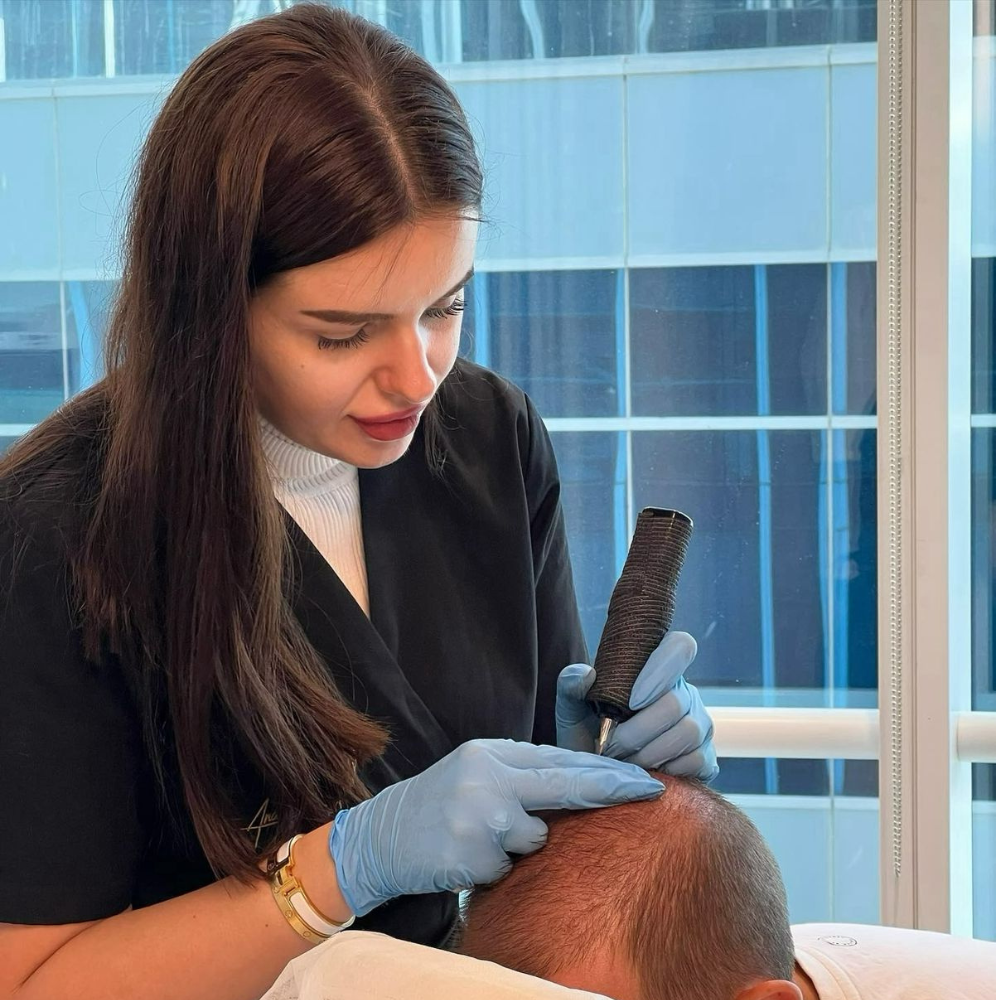
Trichoscopic assessment at Hortman Clinic, Jumeirah — the examination that comes before any serious conversation about finasteride.
Short answer: yes — for the right diagnosis, taken consistently, and with your eyes open about the trade-offs.
Finasteride is the most studied oral medication for male pattern hair loss, and over the years at Hortman Clinic I have sat across from hundreds of men who take it. Some started last month. Some have taken it for more than a decade. Most keep the hair they have. A good number regrow some. A minority stop because of side effects, and a smaller group describe problems that deserve more honesty than either the medication's critics or its defenders usually offer.
This article is what I tell patients when they ask whether they should start, continue, or stop finasteride. It is not a prescription. In the UAE finasteride is a prescription-only medicine, and the decision to take it sits between you and a licensed physician. My role as a clinical trichologist is different: to establish whether your hair loss is the kind finasteride can actually help, to measure what it is doing to your follicles over time, and to tell you the truth about what to expect.
1What finasteride does — and why the diagnosis has to come first
Finasteride blocks an enzyme called 5-alpha reductase (type II), which converts testosterone into dihydrotestosterone, or DHT. In men with a genetic sensitivity, DHT acts on scalp follicles like a slow dimmer switch: each growth cycle gets shorter, each new hair grows finer, until the follicle produces something closer to down than to a proper terminal hair. This process is called miniaturisation, and it is the engine of androgenetic alopecia — male pattern hair loss.
Lower the DHT reaching the follicle and the dimmer switch stops turning. Follicles that were shrinking can stabilise; those that were only partially miniaturised can recover some diameter. That is the whole mechanism. It is elegant, well documented, and completely irrelevant if your hair loss is not driven by DHT.
That last point matters more than most people realise. Hair thinning after illness, surgery, pregnancy, crash dieting or severe stress (telogen effluvium), patchy loss from alopecia areata, scarring alopecias, thyroid- or iron-related shedding, traction from tight styling — finasteride does nothing for any of these. Under the dermatoscope, androgenetic alopecia has a recognisable signature: hair shafts of visibly different thicknesses sitting side by side, more follicular openings producing a single hair instead of two or three, and a characteristic distribution of where the thinning sits. That is why I will not have a serious conversation about finasteride with anyone until we have looked at the scalp at magnification.
Taking a hormonal medication for a non-hormonal problem gives you the side-effect risk with none of the benefit.
Under the dermatoscope, androgenetic alopecia shows hair shafts of visibly different thicknesses sitting side by side.
2Does it work? What the evidence says, and what I see
The evidence base for finasteride is unusual in hair medicine: more than twenty-five years of randomised, placebo-controlled trials and long-term follow-up in men with mild to moderate androgenetic alopecia. The consistent finding is that the large majority of men who take it daily stop losing ground, and a meaningful proportion see visible thickening, most reliably at the crown and mid-scalp. The frontal hairline responds less predictably. Change is slow: the effect builds over six to twelve months, and the first honest assessment point is month six.
In my consulting room, patients on finasteride tend to fall into three groups.
The most common outcome. At twelve months the hair looks much as it did at the start — and that is a win, because the alternative was continued thinning. Patients consistently undervalue this result, and I have learned to show them their baseline trichoscopy images so they can see what "the same" actually means when the natural trajectory was downhill.
Thicker crown, denser mid-scalp, sometimes a noticeably fuller look overall. Almost without exception, these are men who started within the first few years of noticing thinning, while most of their follicles were miniaturised rather than gone. Finasteride protects follicles; it does not resurrect follicles that have fully fibrosed.
A minority. When I look closely there is usually a reason: an advanced stage where too few viable follicles remained, a diagnosis that was never purely androgenetic, or use that was inconsistent enough to matter. Occasionally there is no reason I can find, and that is worth saying plainly.
The single biggest predictor of a good outcome that I see is how early someone starts. The second is whether they actually take it every day.
One more thing patients need to understand before they begin: finasteride is a maintenance medication. Stop, and DHT returns to its previous level; over roughly the following year, the hair returns to the path it was on before. Whatever you gained, you are likely to lose. This is not a course of treatment with an end date.
It is a decision to keep the dimmer switch off for as long as you want the light on.
Is your hair loss the kind finasteride can actually help? A trichoscopy consultation looks at the scalp at magnification to establish the diagnosis first.
3The inconveniences — the honest list
I use the word "inconveniences" deliberately. Some of these are minor practicalities. Some are genuine risks. They belong on the same list, because the decision is made on the whole picture.
1. It is a daily commitment with no finish line
Once a day, indefinitely. Men who travel constantly, who dislike medication on principle, or who are not sure they care enough about their hair to take a tablet for twenty years should think hard about this before starting rather than three months in. Half-hearted use is the worst of both worlds: enough exposure to carry the risks, not enough consistency to earn the benefit.
2. Sexual side effects — the ones everyone asks about
In trials, a minority of men reported reduced libido, difficulty with erections, or changes in ejaculation. In most of them these appeared in the first months, and in most they resolved either while continuing the medication or after stopping it.
There is an uncomfortable wrinkle in the data that I think patients deserve to know about. In one well-known study, men who were explicitly warned about sexual side effects before starting reported them at a markedly higher rate than men given the same medication without that warning. That does not mean the effects are imaginary. It means expectation shapes experience, and it is why I discuss this calmly and factually rather than either dismissing it or dramatising it.
What I see in practice mirrors the literature. Most men on finasteride report no change at all. Those who do notice something usually notice it early. Some stop and recover within weeks. A few continue and find that it settles. I always tell patients: if something changes, tell your doctor and tell me, and we decide together. This is not something to tough out in silence.
3. Mood — and the warnings regulators have added
Depression, anxiety and, rarely, suicidal thoughts have been reported in men taking finasteride. Over the past few years regulators in the United States, the European Union and the United Kingdom have reviewed these reports and strengthened the warnings in the product information; in Europe and the UK, patients are now given an alert card with the medication. As recently as May 2026, the UK regulator updated the warnings again to make clear that sexual side effects may persist after stopping and may themselves contribute to low mood. The absolute risk appears low, but it is not zero, and it is taken seriously.
My rule is simple. If you have a history of depression or anxiety, or you are going through a difficult period right now, that belongs in the conversation with the prescribing doctor before the first tablet. If your mood changes while you are taking it, stop and speak to your doctor — do not wait for your next appointment with me.
4. Post-finasteride syndrome — where I stand
A subset of men report sexual, cognitive and mood symptoms that persist after stopping the medication, sometimes for years. This is described in the literature as post-finasteride syndrome. The scientific community is divided on it: controlled data are limited and the mechanism is not established, and yet the men who describe it are often certain and often distressed.
My position, after listening to a great many patients, is this: it appears to be rare, it is not well understood, and the men who report it deserve to be believed and investigated rather than dismissed. It is also why I take pre-treatment screening seriously, and why I am more cautious with younger men who have a history of mood disorder or who are already very anxious about the medication before they begin.
5. The things that surprise people
- The shed. Some men notice increased shedding in the second or third month. It is usually a sign that follicles are resetting their cycle, and it settles. It is also the single most common reason people stop too early.
- Prostate screening. Finasteride lowers PSA values, the blood marker used in prostate cancer screening. Any doctor interpreting your PSA needs to know you are taking it, or a result can be misread.
- Breast tenderness or enlargement. Uncommon, but it happens. Mention it to your doctor.
- Fertility. Finasteride can reduce semen volume and, in some men, affect sperm parameters. If you are planning a family, discuss timing with your doctor; some men pause the medication while trying to conceive.
- Blood donation. Most blood services defer donors who are taking finasteride, and for a period after stopping, because of the risk to a pregnant recipient. Check with your local donation centre.
- Women. Finasteride is not licensed for female pattern hair loss and is contraindicated in pregnancy. Women who are or may become pregnant should not handle crushed or broken tablets. In post-menopausal women it is occasionally used off-label — a specialist decision, not a starting point.
4What I ask patients to do before they start
A proper baseline: standardised trichoscopy images of the same scalp regions, reassessed at month six and month twelve.
5If oral finasteride is not right for you
Applied to the scalp, it lowers DHT locally with less systemic exposure than the tablet, and the evidence base is growing; a licensed topical product now exists in parts of Europe. It is not automatically side-effect-free — it is still absorbed — and the quality of compounded preparations varies widely. In 2025 the US regulator issued an alert about adverse events linked to compounded topical finasteride, many from men who had been told it carried no risk at all. If you go this route, it should be a properly prescribed, pharmacy-prepared product, not a marketplace purchase.
A related molecule that blocks both types of the enzyme and suppresses DHT more completely. It is licensed for hair loss in only a handful of countries and used off-label elsewhere; the side-effect profile is similar or somewhat higher, and it stays in the body far longer. Some physicians move to it when finasteride has plateaued. This is a physician's decision, and one I only raise once the basics are in place.
Minoxidil, in-clinic photobiomodulation, mesotherapy and regenerative approaches such as exosome-based treatments do not touch DHT. They work on the follicle's environment and signalling instead, which is precisely why they combine well with a DHT strategy. In my practice, the strongest and most durable results come from pairing the two rather than choosing between them. (See: The Follicle Awakening Protocol.)
Surgery relocates follicles; it does not stop the process in the follicles that remain. Most good surgeons want a patient stable on a DHT strategy before and after the procedure for exactly that reason.
Frequently Asked Questions
Less predictably than at the crown. The temples are often the least responsive area. A realistic goal at the hairline is to hold the line rather than to move it forward.
Six months to notice a difference under the dermatoscope; twelve months before judging the result.
Over roughly the following year, the hair returns to the trajectory it was on before you started. Any regrowth you gained is usually lost.
For most men who experience them, yes — within weeks to months of stopping, and sometimes while continuing. A small number of men report persistent symptoms; this is the subject of ongoing research and of recent regulatory warnings.
It is not licensed for female pattern hair loss and must not be taken during pregnancy. In post-menopausal women it is occasionally prescribed off-label by a specialist.
It carries lower systemic exposure and probably fewer side effects, but not zero. Product quality matters, and it should still be prescribed.
Your prescribing doctor may order them. Separately, I often check for contributors to hair loss that finasteride will not fix. If you have prostate screening, your doctor must know you are on finasteride.
The bottom line
Finasteride is neither the villain of the online forums nor the miracle of the before-and-after adverts. It is a well-understood medication that works for a specific diagnosis, in men who take it consistently and who are honest with themselves and their doctor about how they feel on it. The men who do best are the ones who started early, measured properly, and made the decision with the whole picture in front of them.
Whether it belongs in your plan starts with a question that only a magnified look at your scalp can answer: what is actually happening in your follicles?
This article is for general information only. It reflects published evidence and clinical observation at the time of writing and is not medical advice. Finasteride is a prescription-only medicine in the UAE; decisions about starting or stopping it should be made with a licensed physician.
What is actually happening
in your follicles?
Book a trichoscopy consultation with Andreea Paval at Hortman Clinic, Jumeirah, Dubai.